Application Modernization: The Executive Guide for 2026
Published
Most organizations know their legacy systems are slowing them down. Fewer can quantify how much. The answer, when executives see it clearly, tends to accelerate decisions.
The application modernization market is valued at $27.46B in 2026 and projected to reach $67.91B by 2031, a 19.86% compound annual growth rate, according to Mordor Intelligence. That growth reflects a simple reality: organizations spending 60-80% of IT budgets on maintaining aging systems have almost nothing left to compete with. Modernization isn’t optional anymore. It’s the cost of staying in the game.
This guide explains what application modernization actually means, why legacy debt compounds faster than most boards realize, why so many programs stall before delivering returns, and what a well-framed executive conversation on the topic looks like in 2026. For the detailed financial case, Part 2: The Business Case covers PESTEL analysis, ROI frameworks, and board-level justification. Part 3: Technology Deep Dive maps the implementation path, migration strategies, and AI-assisted tooling.
Key Takeaways
- The application modernization market grows from $27.46B in 2026 to $67.91B by 2031 at 19.86% CAGR (Mordor Intelligence)
- Technical debt costs the US economy $2.41 trillion annually and would cost $1.52 trillion to fully resolve (CISQ, via Accenture)
- 97% of large enterprises say one hour of downtime costs more than $100,000 (ITIC 2024)
- AI-driven modernization delivers 40-50% timeline acceleration and 40% reduction in tech debt costs (McKinsey, December 2024)
- 62% of developers cite technical debt as their top frustration, making it a critical talent retention issue (Stack Overflow 2024 Developer Survey)
Why Are Legacy Systems the Silent Budget Crisis?
US federal agencies spend 80% of their IT budgets maintaining existing systems, leaving just 20 cents per dollar for new capabilities, according to a 2025 GAO report. Cross-industry enterprise averages reach 70%, and credit unions top 90%. When three-quarters of IT resources service yesterday’s decisions, organizations cannot respond to market shifts or competitive pressure at the speed modern business demands.
The numbers most executives don’t see until a transformation program forces the issue are stark. US federal agencies spend approximately 80% of their IT budgets on operating and maintaining existing systems, according to a July 2025 U.S. GAO report (GAO-25-107795). That leaves just 20 cents of every dollar for new capabilities. The private sector isn’t far behind.
The pattern repeats across industries. Banks and financial services firms direct 70-75% of IT spending to legacy maintenance. Credit unions push that figure to roughly 90%, per Gartner and Forrester benchmarks analyzed by Profoundlogic. What looks like a technology budget is, in practice, a maintenance budget with a small innovation allowance bolted on.
This matters strategically, not just operationally. When 75% of IT resources are consumed by yesterday’s decisions, the organization’s ability to respond to market shifts, competitive pressure, or regulatory change is structurally limited. Innovation becomes episodic and underfunded rather than systematic.
What Application Modernization Actually Means
The application modernization market reached $27.46B in 2026 and is projected to hit $67.91B by 2031, a 19.86% CAGR driven by organizations that can no longer afford to allocate 60–80% of IT budgets to maintenance. At its core, modernization encompasses six distinct strategies — from minimal-touch re-hosting to full re-architecture — each calibrated to a specific risk and business-value profile.
Application modernization is the process of updating legacy software systems to meet current business needs, using modern architectures, platforms, languages, or delivery models. It’s not a synonym for “rewrite everything.” The spectrum of approaches ranges from minimal-touch re-hosting to full re-architecture.
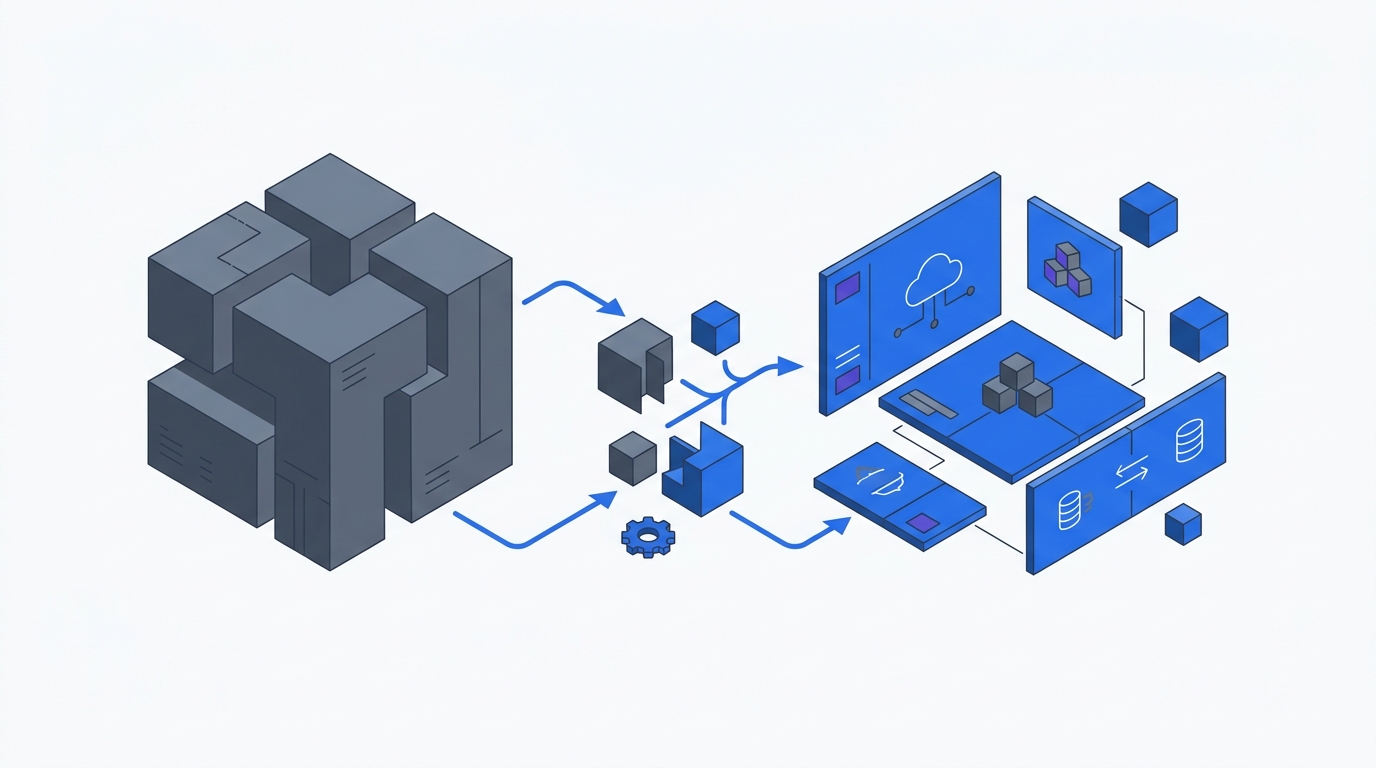
The six core strategies, often described using the “6 Rs” framework, define the modernization spectrum:
Re-host (Lift and Shift). Move the application to a new platform, typically cloud infrastructure, without changing the code. Fastest and cheapest to execute. Delivers limited functional improvement but reduces infrastructure cost and improves resilience.
Re-platform. Make targeted changes to take advantage of the new environment, such as adopting managed database services, without modifying core application logic. A practical middle ground for applications with sound business logic but aging infrastructure.
Re-factor / Re-architect. Restructure the code to improve modularity, scalability, or maintainability without changing external behavior. Often the most technically demanding approach, but it preserves existing logic while enabling future flexibility.
Re-build. Rewrite the application from scratch using modern design patterns and languages. Appropriate when the existing codebase is too degraded to modernize incrementally. High cost, high risk, high potential upside.
Re-place. Retire the custom application and adopt a commercial or SaaS alternative. Works well for commodity functions where differentiation comes from configuration, not custom code.
Retire. Decommission applications that no longer serve a business purpose. Often underestimated as a modernization strategy; eliminating unnecessary systems reduces maintenance cost and security surface immediately.
Traditional vs. Modern Application Architecture
| Dimension | Traditional / Legacy | Modernized Architecture |
|---|---|---|
| Deployment model | On-premise, monolithic | Cloud-native, containerized |
| Release cadence | Months to years | Days to weeks |
| Scalability | Manual, hardware-constrained | Elastic, automated |
| Maintainability | Specialist knowledge required | Standard skills, documented APIs |
| Integration | Point-to-point, brittle | API-first, loosely coupled |
| Observability | Limited logging | Full telemetry and tracing |
| Talent availability | Declining COBOL/legacy pool | Broad modern stack availability |
| Business agility | Low - changes are slow and expensive | High - features deployed on demand |
How Bad Is the Technical Debt Problem?
Technical debt costs the US economy $2.41 trillion annually and would require $1.52 trillion to fully resolve, according to CISQ research reported by Accenture. McKinsey estimates it represents 20–40% of total technology estate value, while 62% of developers cite it as their top professional frustration — making it simultaneously a financial crisis, a productivity drain, and a talent retention risk.
Technical debt is the accumulated cost of architectural shortcuts, deferred upgrades, and aging code that organizations carry on their balance sheet without recognizing it. McKinsey estimates that technical debt represents 20-40% of the entire technology estate value before depreciation, and that 30% of CIOs already divert more than 20% of their new-product budget to resolving it. That’s innovation money being consumed before it reaches customers.
The aggregate numbers make the organizational cost visible at a societal scale. Technical debt costs the US economy $2.41 trillion annually, according to CISQ research reported by Accenture. Fully resolving it would cost an estimated $1.52 trillion. These figures help explain why the modernization market is growing at nearly 20% per year: the cost of inaction is measurable and rising.
The human cost compounds the financial one. The Stack Overflow 2024 Developer Survey, which covers 65,437 developers globally, found that technical debt is the single biggest source of professional frustration, cited by 62% of respondents. That’s not a soft metric. Developers who spend their time fighting legacy systems rather than building new capabilities are more likely to leave. Talent attrition driven by poor technical environments adds recruiting and onboarding cost on top of the productivity loss.
The downtime economics make the risk concrete for boards that think in financial terms. According to the ITIC 2024 Hourly Cost of Downtime Survey, 97% of large enterprises say one hour of downtime costs more than $100,000. For 41% of those organizations, the figure is between $1M and $5M per hour, or more. Legacy systems, which are harder to patch, harder to redeploy, and more likely to have single points of failure, carry disproportionate downtime risk.
Why Do Modernization Programs Stall?
Sixty percent of cloud buyers say their IT infrastructure requires major transformation, yet 82% report their cloud environments also need further modernization, according to IDC’s 3Q24 Cloud Pulse Survey. That scope gap is the primary structural reason programs lose momentum: organizations cannot address an 82% modernization gap in a single program cycle without spreading resources too thin to deliver anything well.
Most application modernization programs don’t fail because the technology is wrong. They fail because the program wasn’t structured to succeed in the first place. The IDC 3Q24 Cloud Pulse Survey found that 60% of cloud buyers said their IT and digital infrastructure requires major transformation, and 82% said their cloud environments also needed modernization. The scope is vast. The organizational capacity to execute often isn’t.
Several recurring patterns explain why programs lose momentum.
Scope that outgrows organizational capacity. An 82% cloud modernization gap, as IDC found, is too large to address in a single program cycle. Organizations that attempt comprehensive transformation simultaneously spread resources too thin to deliver anything well. Sequenced, phased approaches with clear dependency mapping consistently outperform big-bang programs.
Unclear ownership between IT and the business. Application modernization is not an IT project. It’s a business change program that IT executes. When business units aren’t accountable for outcomes, the business case weakens the moment priorities shift. The most durable programs we’ve observed embed business product owners alongside technical leads from the start.
Underestimating the talent gap. Legacy systems are often maintained by a small group of specialists with institutional knowledge that isn’t documented anywhere. When those individuals leave, or when the program requires skills the organization doesn’t have, costs escalate and timelines slip. The Stack Overflow 2024 survey finding that 62% of developers cite technical debt as their primary frustration signals that talent pressure cuts both ways: legacy environments repel the modern skills needed to fix them.
Treating cloud migration as modernization. Moving workloads to cloud infrastructure without changing how applications are built or maintained is re-hosting, not modernization. IDC found that 82% of cloud environments themselves require further modernization, which suggests many organizations discovered this distinction after the fact.
How Is AI Changing Application Modernization?
AI-driven modernization delivers 40–50% timeline acceleration and a 40% reduction in tech debt remediation costs, according to McKinsey’s December 2024 analysis. Gartner projects that GenAI tools will reduce legacy application modernization costs by 70% by 2027. For programs that were previously borderline viable on cost-benefit grounds, these figures fundamentally shift the approval calculus.
Generative AI is changing the economics of modernization faster than most modernization roadmaps anticipated. Gartner predicted in March 2024 that GenAI tools will reduce legacy application modernization costs by 70% by 2027. That’s a material shift in the cost-benefit math for programs that were previously borderline viable.
McKinsey’s December 2024 analysis found that AI-driven modernization delivers 40-50% acceleration in timelines alongside a 40% reduction in tech debt remediation costs. These are not vendor-commissioned figures. They reflect McKinsey’s analysis of actual program outcomes at enterprise scale.
The mainframe modernization data is even more striking. The Kyndryl 2024 State of Mainframe Modernization Survey found that 86% of enterprises are now adopting AI or GenAI for mainframe modernization efforts. The same survey reported one-year ROI of 114-225% and $11.9B in collective annual savings across surveyed organizations. Mainframe modernization, long treated as an intractable problem, is being reshaped by AI-assisted code analysis, automated documentation generation, and intelligent refactoring tools.
What does this mean practically? Programs that were planned over five years may be achievable in three. Budget envelopes that couldn’t clear the board approval threshold may now make the case. And organizations that delay are not simply deferring cost: they’re forfeiting the efficiency advantage that AI tooling provides, while competitors who move earlier lock in lower per-unit modernization costs.
The Forrester Wave for Application Modernization and Migration Services (Q1 2024) characterized the market as on the verge of dramatic change driven by GenAI capabilities. That assessment is already materializing in vendor roadmaps and early enterprise outcomes.
Frequently Asked Questions
What is the difference between application modernization and digital transformation?
Digital transformation is the broad organizational shift toward digital-first operations, culture, and business models. Application modernization is one specific component of that shift, focused on the software systems that underpin business operations. You can modernize applications without achieving digital transformation. But you cannot achieve meaningful digital transformation without modernizing the applications that deliver it. Most organizations use the terms interchangeably, which creates scope confusion in program planning.
How long does an application modernization program typically take?
Enterprise-scale programs typically run three to seven years, depending on the size of the portfolio and the depth of modernization required. Early workstreams, such as retiring unused applications, re-hosting non-critical systems, and establishing cloud landing zones, can show measurable progress within the first 12 months. The full 70% cost reduction that Gartner projects from GenAI tooling by 2027 suggests that organizations who start now will complete programs faster and cheaper than those who wait another two years.
Is application modernization only relevant for large enterprises?
No. The budget math applies at every scale. Mid-market organizations spending 60-70% of IT resources on legacy maintenance face the same innovation constraint as large enterprises, often with less capital to absorb a transformation program. The availability of SaaS alternatives for commodity functions, managed cloud services, and AI-assisted migration tooling has lowered the entry cost significantly. The “re-place” strategy, adopting modern commercial software in place of custom legacy systems, is particularly accessible for mid-market organizations.
What is the right sequence for a modernization program?
Start by retiring what isn’t needed. Eliminating systems that no longer serve a business purpose reduces cost, security surface, and program complexity immediately. Then prioritize re-hosting systems where cloud infrastructure benefits are clear but business logic is sound. Reserve re-architecture and re-build efforts for systems where differentiation and agility are strategically important. The sequencing should be driven by business value and risk, not technical convenience. For detailed implementation sequencing, see Part 3: Technology Deep Dive.
How should we present the business case to the board?
Frame the conversation around the cost of inaction, not the cost of the program. The $2.41 trillion annual US technical debt cost (CISQ, via Accenture) and the ITIC finding that 97% of large enterprises face downtime costs above $100,000 per hour give boards a financial frame that is immediately legible. Then position the program as risk reduction and capability investment, not IT housekeeping. The detailed PESTEL framework, ROI modeling, and board presentation structure are covered in Part 2: The Business Case.
Q: How does technical debt directly affect developer productivity and talent retention?
Technical debt is the number-one source of professional frustration for 62% of developers globally, according to the Stack Overflow 2024 Developer Survey of 65,437 respondents. Engineers spending their time fighting legacy systems rather than building new capabilities are measurably more likely to leave, adding recruiting and onboarding costs on top of productivity losses that compound annually.
Q: What does AI-assisted modernization mean for program timelines and budgets?
McKinsey’s December 2024 analysis found AI-driven modernization delivers 40–50% timeline acceleration alongside a 40% reduction in tech debt remediation costs. A program previously scoped at five years may now be achievable in three. Gartner projects a 70% cost reduction for organizations acting by 2027, making delayed programs progressively more expensive relative to early movers who lock in lower per-unit modernization costs.
Q: How large is the application modernization market and what is driving its growth?
The application modernization market is valued at $27.46B in 2026 and projected to reach $67.91B by 2031, a 19.86% CAGR, according to Mordor Intelligence. The primary driver is the compounding cost of inaction: organizations spending 60–80% of IT budgets on legacy maintenance have structurally limited capacity to compete, and the AI tooling that now makes modernization faster and cheaper is accelerating the decision timeline across all industries.
Q: Why does downtime risk make the modernization case for risk-focused board members?
According to the ITIC 2024 Hourly Cost of Downtime Survey, 97% of large enterprises say one hour of downtime costs more than $100,000. For 41% of those organizations, the hourly cost reaches $1M–$5M or more. Legacy systems carry disproportionate downtime risk because they are harder to patch, harder to redeploy, and more likely to have single points of failure — making them a direct financial liability for every hour they remain in production.
Conclusion
Application modernization is not a technology refresh program. It’s a strategic intervention in how your organization funds its future. When 70-80% of the IT budget is locked into maintaining systems that were built for a different era, the organization’s capacity to respond, compete, and innovate is structurally constrained. That constraint compounds every year the program is deferred.
The good news is that the economics shifted. AI-driven tooling is reducing modernization costs by 40% and compressing timelines by nearly half, according to McKinsey. Gartner projects a 70% cost reduction for organizations that act by 2027. The Kyndryl mainframe data shows 114-225% one-year ROI is achievable even in the most daunting legacy environments. The cost-benefit case, which was once marginal for many portfolios, has moved decisively in favor of action.
The critical question for executive teams in 2026 isn’t whether to modernize. It’s whether to design the program well enough to capture the returns that AI-assisted modernization now makes accessible. That requires a business case that boards can act on and a technology roadmap that teams can execute.
Continue with Part 2: The Business Case for the PESTEL analysis, ROI frameworks, and financial justification your board needs. Then see Part 3: Technology Deep Dive for the implementation roadmap, migration strategies, and AI tooling that makes it executable.