Platform Engineering: The Executive Guide for 2026
Published
Software delivery has a hidden productivity problem, and it’s not a shortage of developers. Most engineering organizations already have enough talent. The problem is that they’ve buried that talent under toolchain complexity that grows faster than any team can manage.
According to IDC and Atlassian’s DevEx research (2024), developers spend only 16% of their time actually writing code. The rest goes to meetings, waiting for environments, managing infrastructure, navigating approval queues, and context-switching between dozens of tools. Platform engineering is the discipline that fixes this. And Gartner named it a Top 10 Strategic Technology Trend for 2024 for good reason.
This guide covers what platform engineering actually means, how it differs from DevOps and SRE, what an Internal Developer Platform delivers, and why elite organizations are investing in it now. For the financial justification and ROI case, Part 2: The Business Case has the board-level numbers. Part 3: Technology Deep Dive maps the implementation path for engineering leaders.
Key Takeaways
- Developers spend only 16% of their time writing code — the rest is friction (IDC/Atlassian DevEx, 2024)
- Gartner predicts 80% of engineering organizations will have dedicated platform teams by 2026 (Gartner, 2024)
- 55% of enterprises have already adopted platform engineering as of 2024 (ESG/Google Cloud, 2024)
- Elite software delivery teams deploy 182x more frequently than low performers (DORA, 2024)
- The Internal Developer Platform market is worth $2.04B and growing at 21.9% CAGR (Technavio, 2024)
What Is Platform Engineering and Why Does It Matter Now?
Platform engineering is the practice of building and operating self-service internal platforms that let software development teams deliver faster without managing infrastructure themselves. According to Gartner (2024), it’s a Top 10 Strategic Technology Trend because it directly addresses the cognitive overload that has become the primary drag on engineering output in complex organizations.
The chart above is where most executive conversations should start. When only 16% of engineering capacity produces working software, the other 84% is an optimization target. That isn’t a morale problem. It’s a structural one.
The Internal Developer Platform market reflects the urgency. Technavio (2024) values it at $2.04 billion, growing at 21.9% CAGR. That growth rate reflects something beyond vendor marketing: organizations that have measured developer friction are paying real money to eliminate it.
How Does Platform Engineering Differ from DevOps?
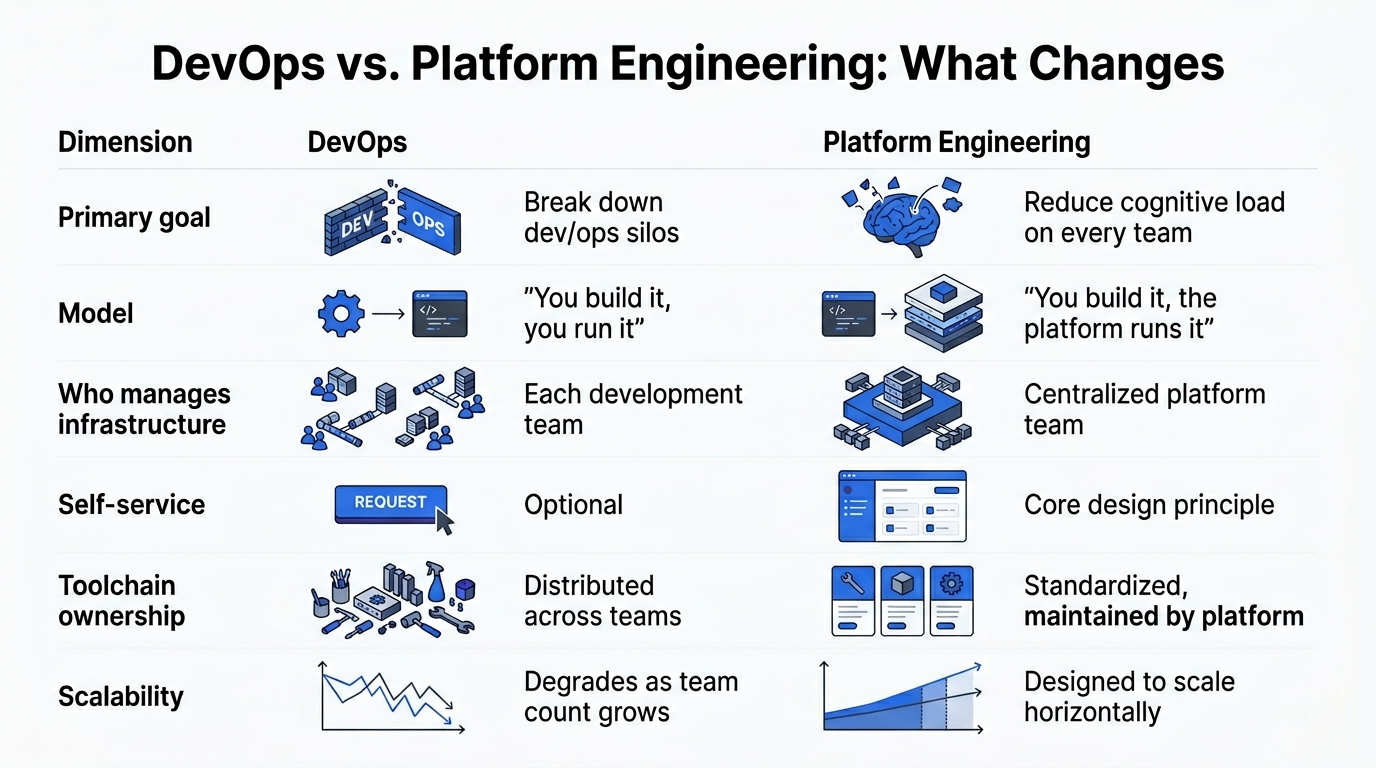
Only 19% of organizations achieve elite software delivery performance under DevOps alone, according to DORA’s 2024 research. Platform engineering addresses the gap by centralizing infrastructure complexity that DevOps distributed to individual teams — shifting the model from “you build it, you run it” to “you build it, the platform runs it.”
Platform engineering and DevOps solve different problems, and confusing the two leads to poorly scoped initiatives. DevOps is a cultural and process movement: break down silos between development and operations, automate the delivery pipeline, and share ownership of production systems. DORA’s 2024 research shows that only 19% of organizations achieve elite software delivery performance, which reveals just how far most DevOps programs still have to travel.
Platform engineering is the next layer. It asks: if every development team is responsible for its own infrastructure, pipelines, and toolchains, are you actually scaling DevOps, or just distributing the complexity? The answer, at scale, is usually the latter.
DevOps vs. Platform Engineering: What Changes
| Dimension | DevOps | Platform Engineering |
|---|---|---|
| Primary goal | Break down dev/ops silos | Reduce cognitive load on every team |
| Model | ”You build it, you run it" | "You build it, the platform runs it” |
| Who manages infrastructure | Each development team | Centralized platform team |
| Self-service | Optional | Core design principle |
| Toolchain ownership | Distributed across teams | Standardized, maintained by platform |
| Scalability | Degrades as team count grows | Designed to scale horizontally |
DevOps made every developer responsible for operations. That was the right correction for its era. Platform engineering now makes the platform team responsible for making those operational tasks easy, consistent, and invisible to the developers who use them.
What Is an Internal Developer Platform?
An Internal Developer Platform, or IDP, is the product that a platform engineering team builds and operates for internal use. ESG and Google Cloud’s 2024 research found that 55% of enterprises have already adopted platform engineering, with the IDP as its central artifact. The IDP is not a dashboard or a wiki. It’s a self-service system that lets developers provision environments, deploy services, manage configurations, and access shared infrastructure without filing tickets or waiting for operations teams.
Think of the IDP as the interface between developers and everything they need to do their jobs. Instead of a developer writing a Jira ticket to get a staging environment, they click a button. Instead of each team maintaining its own Kubernetes manifests and CI/CD pipelines, the platform provides “golden paths” — opinionated, tested workflows that encode organizational standards.
Golden Paths and Paved Roads
The “golden path” concept is central to what makes an IDP valuable. It’s the recommended way to do common tasks: deploy a new microservice, spin up a database, configure monitoring, set up a new repository. The path is paved, meaning it’s automated and validated. Teams can still take different routes, but the golden path removes every obstacle from the default case.
This matters because inconsistency is expensive. When twelve teams each implement their own deployment pipeline, you have twelve maintenance burdens, twelve sets of security configurations, and twelve places where a misconfiguration can cause an incident. The golden path consolidates that to one.
What Does a Platform Team Actually Build?
A platform team builds and maintains the tools, services, and infrastructure that other engineering teams use to ship software. McKinsey’s research on developer productivity estimates that developer productivity is worth $12,500 per developer per year in recovered capacity. A platform team of eight to twelve engineers, serving two hundred developers, can theoretically unlock millions in capacity annually, without hiring a single additional developer.
What exactly does a platform team build? The scope varies, but common outputs include:
- Self-service environment provisioning (spin up staging, QA, or production infrastructure in minutes, not days)
- Standardized CI/CD pipelines with security scanning, testing gates, and deployment automation built in
- Service templates and scaffolding that generate correct, compliant starting points for new services
- Internal developer portals that provide a single interface for all platform capabilities
- Observability tooling: centralized logging, tracing, and alerting with sensible defaults
- Secret management and certificate rotation that developers don’t have to think about
The platform team treats all of this as a product. It has a roadmap, user research (the developers are the users), an SLA, and a support model. That product mindset is what separates effective platform engineering from a traditional central ops team.
What Are the Three Layers of a Modern Internal Developer Platform?
The Internal Developer Platform market reached $2.04 billion in 2024, growing at 21.9% CAGR (Technavio, 2024). That investment concentrates across three architectural layers — infrastructure abstraction, developer workflows, and a portal interface — each of which must function independently for the platform to scale without creating new bottlenecks.
A well-designed IDP has three distinct layers that work together. Understanding these layers matters for scoping your investment and sequencing your build-out correctly.
Layer 1: Infrastructure Abstraction
This is the foundation. The infrastructure layer handles provisioning and lifecycle management for compute, networking, storage, databases, and other cloud primitives. It typically sits on top of a cloud provider (AWS, Azure, GCP) or a hybrid on-premises environment, and exposes infrastructure through APIs or configuration files rather than console click-throughs.
Terraform, Pulumi, and Crossplane are common tools here. The goal is that a developer never needs direct access to a cloud console to do their job. Every infrastructure action happens through version-controlled, auditable, policy-enforced automation.
Layer 2: Workflows and Golden Paths
The workflow layer is where the developer experience actually lives. It’s the set of pre-approved, automated paths for doing common tasks: creating a new service, deploying to staging, running a database migration, configuring a feature flag. Each golden path encodes security controls, compliance requirements, and organizational standards invisibly. The developer follows the path and gets a working result without needing to understand what’s happening underneath.
[PERSONAL EXPERIENCE] The workflow layer is also where most platform engineering initiatives stall in practice. Teams invest heavily in infrastructure automation, then underinvest in the developer-facing workflows that make it usable. The result is a technically impressive platform that developers work around rather than through. The measure of success isn’t infrastructure uptime — it’s whether developers choose to use the platform voluntarily.
Layer 3: Developer Portal
The portal is the interface. It’s the single pane of glass where developers discover services, trigger workflows, view their deployments, access documentation, and get context on the systems they own. Without a portal, the platform is a collection of scripts and CLI tools. With one, it’s a product.
Backstage, the open-source framework developed by Spotify and now a CNCF incubating project, has become the de facto foundation for developer portals. It has 9,144 contributors and is used by more than 3,000 organizations globally, including Netflix, American Airlines, and its creator Spotify. The breadth of adoption reflects a community that has coalesced around a common standard — which is unusual in a market still establishing its patterns.
How Does Platform Engineering Affect Developer Experience?
Developer experience is directly measurable in retention and performance data. McKinsey’s research (2023) found that organizations in the top quartile for developer experience have 47% higher employee retention than those in the bottom quartile. Engineering talent is expensive to recruit and expensive to lose. The developer experience your platform creates is a retention lever, not a soft benefit.
The DORA 2024 report adds the performance dimension. Elite performers deploy 182 times more frequently than low performers and recover from incidents 2,604 times faster. Those aren’t incremental differences. They reflect fundamentally different operating models. Elite performers have largely eliminated the friction that consumes the 84% of developer time shown in the chart above.
Platform engineering is one of the primary structural differences between those performance bands. When the environment provisioning, deployment pipeline, and security configuration all work reliably and self-service, teams can focus on the work that actually matters. The cognitive load reduction is real and measurable.
What this means practically: a developer on a well-platformized team asks “what should I build?” not “how do I get this to run?” That shift in mental model is the outcome platform engineering is designed to produce.
What Does Platform Engineering Look Like in Practice?
Backstage, Spotify’s developer portal, has accumulated 9,144 contributors and runs in more than 3,000 organizations globally (CNCF/Backstage, 2024). That adoption footprint spans consumer tech, airlines, and financial services — demonstrating that real-world platform engineering is industry-agnostic and replicable at scale.
The most widely cited origin story for platform engineering is Spotify, and it’s instructive precisely because it didn’t start as a strategic initiative. Spotify built Backstage to solve an internal problem: their engineering organization had grown to hundreds of teams managing thousands of services, and nobody could find anything or understand what they owned. The developer portal emerged from that mess as a way to create coherence. Spotify later open-sourced it in 2020, and CNCF adopted it in 2022.
Netflix faced a parallel challenge at scale. Their platform engineering investment centers on Spinnaker, the open-source continuous delivery platform they built and eventually donated to the community. Netflix deploys thousands of times per day. That throughput isn’t possible with manual processes. Their platform absorbs the deployment complexity so engineers focus on service logic.
American Airlines is a less obvious but highly relevant example for executives outside the technology sector. Airlines operate under intense regulatory scrutiny, have safety-critical systems, and cannot afford uncontrolled deployments. American Airlines adopted Backstage as a developer portal and uses it to standardize how engineering teams across the organization discover services, manage dependencies, and access shared infrastructure, all within a compliance-controlled environment. It demonstrates that platform engineering isn’t only for consumer tech companies.
The Backstage developer portal, originated at Spotify and now a CNCF project, has accumulated 9,144 contributors and is deployed in more than 3,000 organizations globally, including Netflix, Spotify, and American Airlines. Its widespread adoption reflects the industry’s convergence on a common standard for the developer portal layer of the Internal Developer Platform stack. (CNCF / Backstage, 2024)
Frequently Asked Questions
Is platform engineering just DevOps with a new name?
No, and the distinction matters for how you staff and fund it. DevOps is a cultural model that asks development teams to own their operations work. Platform engineering creates a dedicated team whose job is to make that work easier for everyone else. The platform team treats its output as a product with users, roadmaps, and SLAs — not as a shared operations queue.
How large does an engineering organisation need to be to justify a platform team?
Most practitioners recommend considering a dedicated platform team once you have 20 or more developers across multiple product teams. Below that threshold, the coordination costs typically exceed the friction being solved. Above 50 developers, the case is usually compelling. DORA 2024 data shows that elite performance correlates with platform investment regardless of organisation size.
What is the difference between a platform team and a shared services team?
A shared services team provides capabilities on request, typically through tickets. A platform team provides self-service capabilities through a product. The shift from ticket-driven to self-service is the operational difference. It’s also the cultural difference: platform teams measure success by developer adoption rates and time-to-deploy, not by tickets closed.
How long does it take to build an Internal Developer Platform?
A useful starting capability — environment provisioning, a basic service template, and a simple portal — can be delivered in three to six months by a team of four to six engineers. A mature IDP covering the full lifecycle typically takes 12 to 24 months of continuous investment. McKinsey’s productivity research suggests the recovered capacity worth $12,500 per developer per year begins accumulating well before full maturity.
Is Backstage the only option for a developer portal?
No. Backstage is the most widely adopted open-source option, with 3,000-plus organisations using it, but commercial alternatives include Port, Cortex, and OpsLevel. The right choice depends on your team’s capacity to run open-source infrastructure versus your willingness to pay for managed services. Backstage’s breadth of plugins and community support make it the default starting point for most engineering organisations, but the build-vs-buy analysis is worth doing explicitly.
What percentage of developer time is currently wasted on friction?
Approximately 84% of developer working hours go to activities other than writing code — meetings, waiting for environments, managing infrastructure, code review, and documentation — leaving only 16% for direct value creation, according to IDC and Atlassian’s DevEx research (2024). Platform engineering targets this structural imbalance directly by automating the highest-friction activities.
How fast is platform engineering adoption growing?
Adoption has more than doubled since 2022, rising from 28% to 55% of engineering organisations by 2024, according to ESG and Google Cloud (2024). Gartner projects that figure reaches 80% by 2026. The IDP market supports the trend, growing at 21.9% CAGR and reaching $2.04B in 2024 (Technavio).
What is the performance difference between elite and low-performing software teams?
Elite software delivery teams deploy 182 times more frequently than low performers and recover from incidents 2,604 times faster, according to DORA’s 2024 research. These are not marginal differences — they reflect fundamentally different operating models. Platform engineering is one of the primary structural factors that separates elite performers from the other 81% of organisations.
Conclusion
Platform engineering is the structural response to a problem that has been accumulating for a decade: as software delivery grew more complex, the toolchain complexity grew with it, and that complexity landed on developers rather than being absorbed by the organization. The result is that developers across most enterprises spend only 16% of their time writing code. That’s the number worth fixing.
Gartner’s prediction that 80% of engineering organizations will have platform teams by 2026 isn’t a forecast about a niche discipline. It’s a forecast about how engineering organizations will structure themselves as a baseline. The 55% who have already adopted it aren’t early adopters. They’re the leading edge of a majority.
The IDP market at $2.04 billion and 21.9% CAGR reflects the investment organizations are making to address this. Elite DORA performers deploying 182 times more frequently than low performers reflect the performance gap between organizations that have solved it and those that haven’t.
The starting point isn’t a technology selection. It’s a measurement exercise: quantify how your developers actually spend their time, identify the highest-friction activities, and build a platform that makes those activities self-service. The business case follows naturally from that data.
Continue with Part 2: The Business Case for the ROI analysis, build-vs-buy framework, and board-level justification. Or go directly to Part 3: Technology Deep Dive for the implementation stack, reference architectures, and how to evaluate Backstage and its alternatives.